 BIM Support
Special Features: CBLI Cost Estimation Report
This report category helps you get an insight on available container related costs for Carrier Bill of Lading Instructions (CBLIs).
To view this report category
- Navigate to Business Intelligence>Reports.
- Select CBLI Cost Estimation Report.

Figure 1
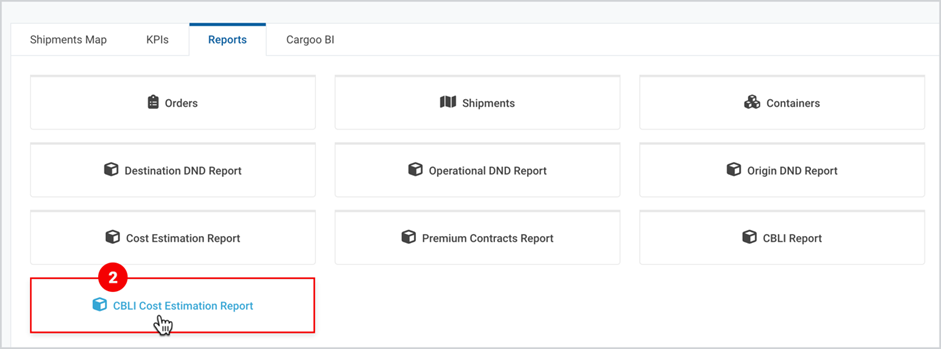
Figure 2
Before generating a report, make sure that
- You’re using the right Company account.
(For more details, please see Business Intelligence: Reports Section article.) - You have checked the Data for multiple companies: section and have selected all the companies for which you are looking to get the data .
(For more details, please see Common Features: Data for Multiple Companies article.) - All Filters and Additional Filters are set.
(To set the Filters and Additional Filters follow the steps described in Filters and Additional Filters.)
Tip | Save the filter configurations as a template in case you use the same filter configurations repeatedly, or use existing templates if any. |
Once all filters are set, generate a report and use report table features to view and analyze the report online or use the provided options to download or save it to preferred file formats.
(For more details on report table features, please see Common Features: Report Table article.)
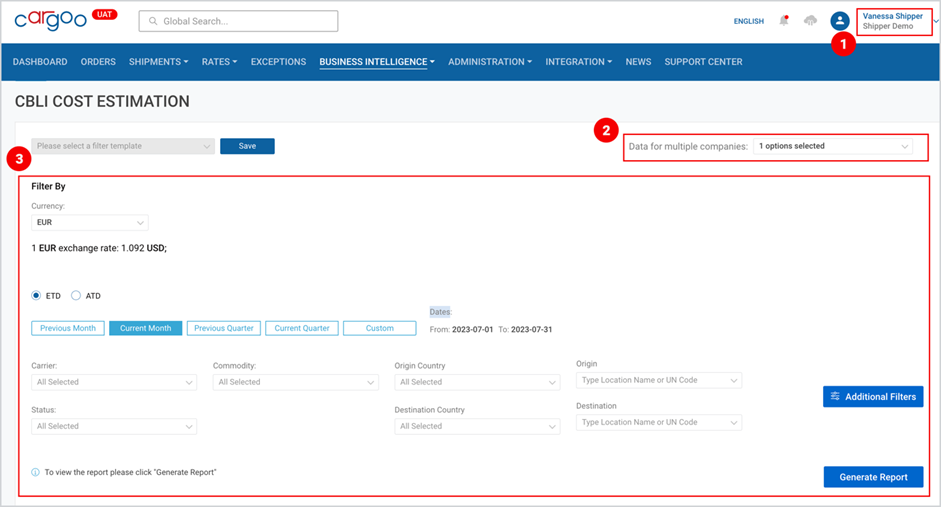
Figure 3
Aside from the Common features, the CBLI report category offers the following special features:
- Filter by
- Additional Filters
Filter by
To set the filters
- Select Currency. Below the searchable drop-down menu, you can find currency exchange rates, the information on the latter is given relative to the currencies used in your contracts.
For example: If you have used different currencies in your contracts, e.g., EUR, USD, RMB, and JPY, and you choose to convert them to USD, you will see the exchange rates for all 3 (three) – EUR to USD, RMB to USD, and JPY to USD rates. - Select between ETD and ATD (ETD is selected by default).
- Select the time period from the provided options: Previous Month, Current Month, Previous Quarter, Current Quarter, or Custom (use the calendars to select From and To dates).
- Use the drop-down menus of the following filters to narrow down the search results and filter the data accordingly.
- Carrier,
- Commodity,
- Shipment Status,
- Origin Country,
- Destination Country.
5. Type in the Location Names or the UN Codes (UN/LOCODE) for the Origin and
the Destination.
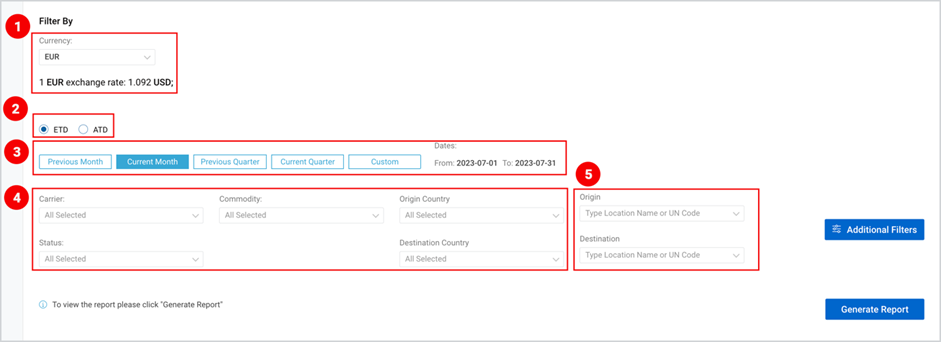
Figure 4
Additional Filters
Additional Filters allow you to filter the data per your role in the shipments and/or add additional parties to the report.
Select Your Role in Shipment
Select Additional Filters.
- Select one of the three filter options:
- My Shipments — Shipments created by you or by companies selected in Data for Multiple Companies.
- Observer — Shipments where you or the companies selected in Data for Multiple Companies are added as Further Parties.
- All — This option includes the above-mentioned two filter options and is selected by default.
- Click Apply.
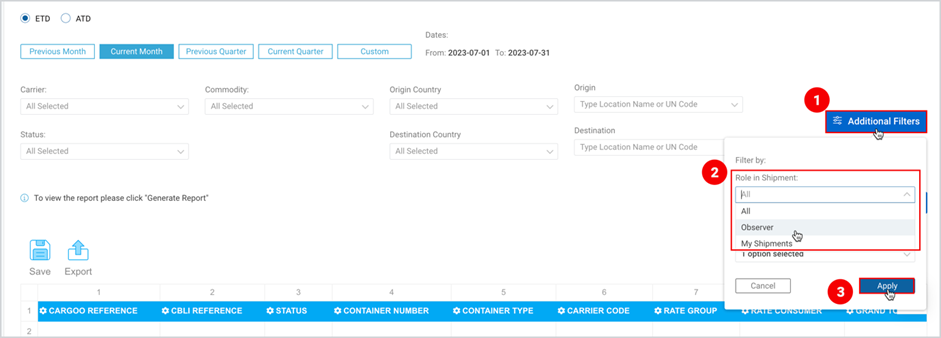
Figure 5
Show in Report: Parties (Business Partners)
To add more Parties to the report
- Select Additional Filters.
- Open the drop-down menu for Parties and select more Parties or deselect the default selected option. By default, only Delivery Location is selected.
- Click Apply.
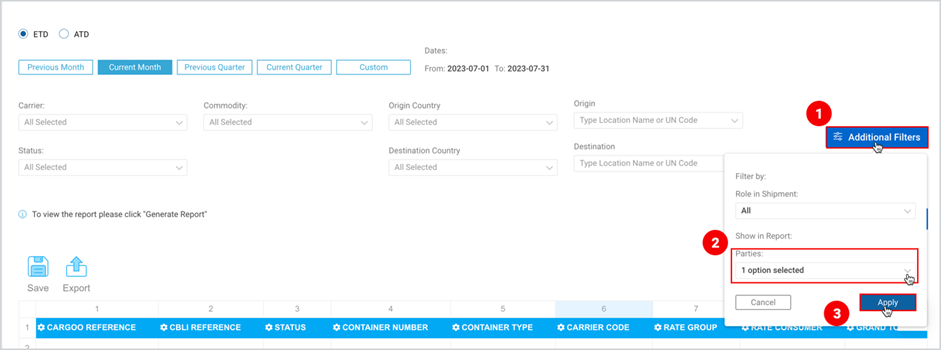
Figure 6
By default, only Supplier is selected.
This field does not filter. If the shipment has no data about the field, it is still shown in the list with an empty field.
To download the print version of this article click the PDF icon: